Brand valuation is a snapshot. It captures momentum at a moment in time — the accumulated trust, recognition, and equity a brand has built. What it cannot measure is governance risk. What sits underneath the equity. What holds the brand together when the person who built it is suddenly gone.
Nine months before the crisis, Nvidia made a smart decision: it hired its first-ever Chief Marketing Officer. Alison Wagonfeld, a veteran of Google Cloud marketing, joined in February 2026 — reporting directly to Jensen Huang, with responsibility for global marketing and communications. Not a support hire. A structural signal. Nvidia was recognizing, for the first time, that it needed someone whose job was the brand itself.
Then came eleven days that reframed everything she had been building.
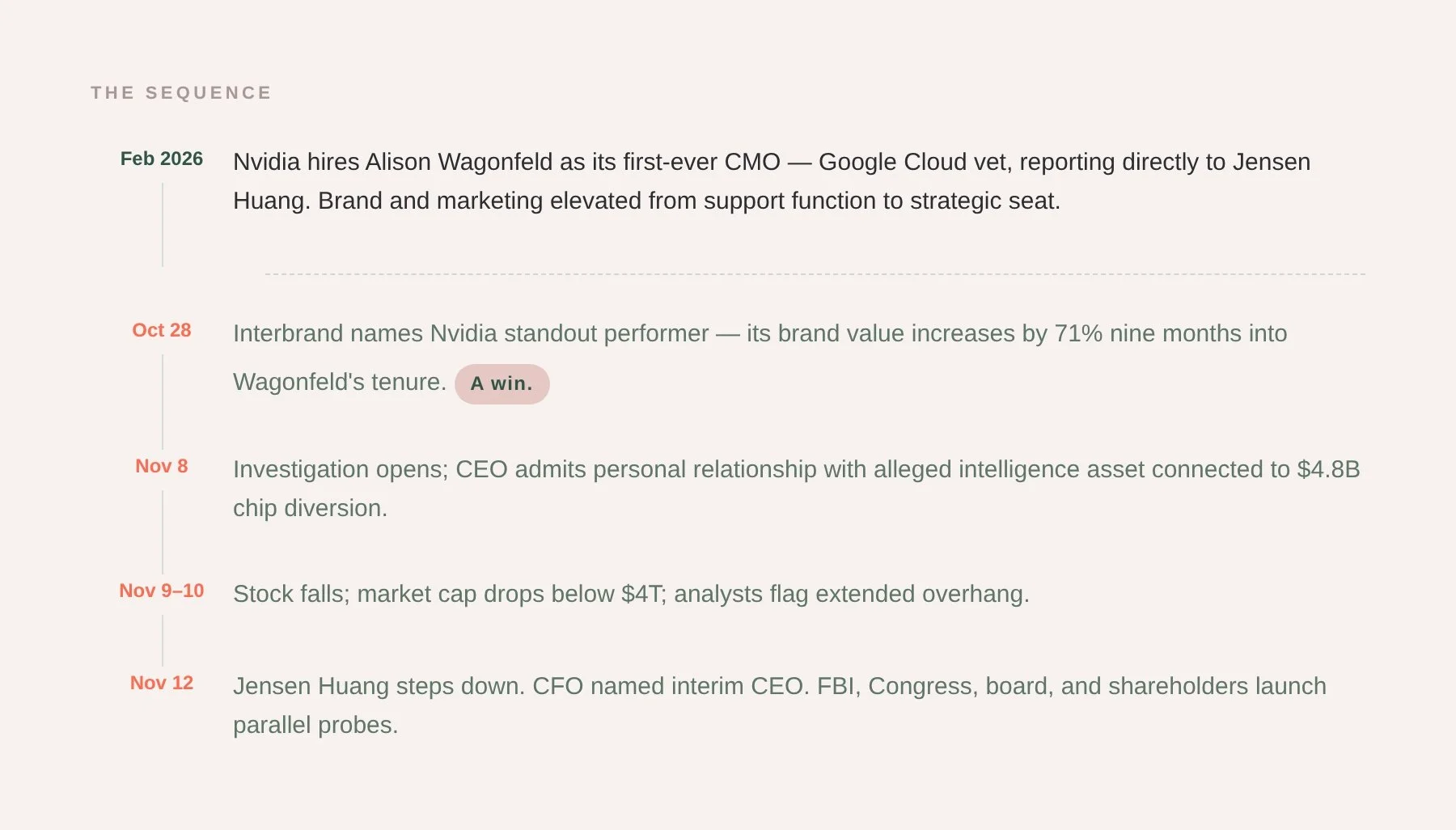
Wagonfeld is now nine months into the work of building something Nvidia had never had before — institutional brand infrastructure — and the institution just had its most significant leadership failure in its history. What she built in those nine months is about to be tested in ways she could not have anticipated when she took the role.
Nvidia Had a Vision for the Brand. They Just Didn't Know How Soon They'd Need It.
Jensen Huang built Nvidia over 31 years. The leather jacket. The sold-out keynotes. The cultural figure who made chips feel like destiny. That is not marketing — that is a founder whose persona became load-bearing for the brand. Investors, enterprise customers, and the broader AI ecosystem didn't just trust Nvidia's products. They trusted the person who stood behind them and said, “Here is where this goes next.”
When a brand's identity lives primarily in one person, the brand is only as stable as that person. Nvidia's leadership understood this — not as crisis planning, but as a growth ambition. The Wagonfeld hire was the investment: a first-ever CMO, elevated to report directly to the CEO, with a mandate to build brand architecture that could sustain and scale independently of any one person. That is not a communications role. That is a brand governance role.
At Google Cloud, Wagonfeld built marketing infrastructure for a business competing against Amazon and Microsoft not on consumer preference, but on institutional credibility—trust with enterprise buyers, government customers, and partners who needed to believe in the organization, not just the product. That is precisely the brand management challenge Nvidia was hiring for.
Here's the question her appointment raised — and the question this crisis will now answer: how much institutional brand work can you build in nine months?
“Brand governance isn’t crisis prevention. It’s the work you do before the crisis so the brand has something to hold onto when it arrives.”
Nine Months — and the Crossroads She's Standing At
I spent years working in hospitality brand management, and the first thing the industry teaches you is that the brand cannot live in anyone's head. Not the GMs. Not the VP's. Not the founders. If it does, it leaves with them. The job of a brand manager — the real job, not the title — is to make the brand institutional: documented, embedded, transferable.
At The Ritz-Carlton, the Gold Standards — The Credo, The Motto, The Three Steps of Service — are not values statements. They are operational documents. They exist in training programs, in daily lineups, in the onboarding of every new employee at every property in every market. When a general manager leaves, the brand does not follow them out the door. That work takes years, not months. But it starts with one decision: someone whose job it is to build it.
Apple after Steve Jobs is the most visible proof of this at scale. The brand survived his death not because Tim Cook replaced Jobs, but because the design philosophy, the product standards, and the brand governance were embedded in systems, processes, and culture that existed independently of one person. That work is brand management. It is deliberate, unglamorous, and largely invisible until the moment it is tested.
Wagonfeld has been doing that work. The question is what she was able to build in nine months — and what the crisis is now asking of it.
If the governance infrastructure is in place — documented brand standards, defined positioning that exists independently of the founder, board-level oversight of brand equity as a material asset — she has something to hold onto. The brand has a floor. She can lead from it.
If the work was still largely in the building phase — which is entirely possible, even likely, nine months into a first-ever mandate at a company this size — the crisis arrives before the scaffolding is complete. That doesn't mean the brand can't survive. It means she has to build and hold simultaneously, under conditions no one would choose.
Either way, she is now doing the most important brand governance job in technology. The whole industry is watching whether Nvidia's investment in brand leadership nine months ago was enough — and whether that leadership can hold something this large together.
Specifically, what brand management and governance structure can provide — and what Wagonfeld was hired to build:
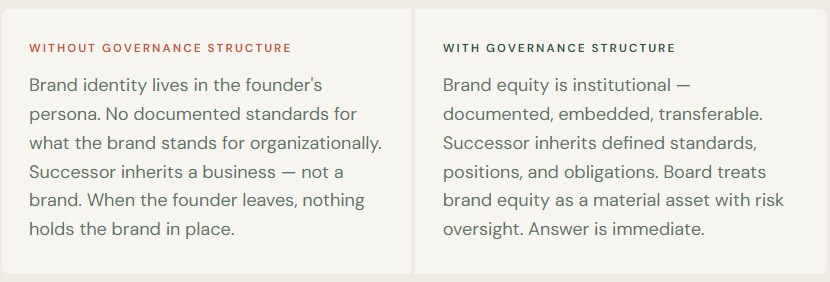
Most boards have audit, compensation, and risk committees. Almost none have a brand equity governance function. Nvidia made the right move by hiring a CMO. The harder move — building brand governance into board-level oversight, treating brand equity as a material asset with the same rigor as any other $300B line item — takes longer than nine months. That is the work that most organizations never do until a crisis forces their hand.
Could Nvidia Be the Next Tesla?
Could Nvidia become the next Tesla — a trillion-dollar brand built around a founder's persona, now navigating what happens when that persona becomes the risk? The difference may be Alison Wagonfeld: Nvidia has someone whose job, for the past nine months, has been making the brand bigger than any one person. Tesla never made that investment. Yes, Telsa does NOT have a CMO.
So what does this mean?
It is highly unlikely that most companies will ever find themselves in such a deep scandal. In many respects, this is a PR crisis. Thanks to social media and AI as an amplifier, this is also a brand crisis.
Nvidia got the first part right: they hired the right person, elevated the function, and gave her a direct line to the CEO. That is more than most companies do, and it deserves to be recognized as a strategic decision — not a communications afterthought. Whether nine months was enough time to build the institutional scaffolding the brand now needs is a question only she can answer. I hope it was.
What I know from years of watching brand equity get built and lost up close is this: the organizations that survive leadership crises are the ones where someone did the unglamorous work of making the brand institutional before the test arrived. Not the ones with the best campaigns. Not the ones with the most brand value at the peak. The ones where the brand had somewhere to land when leadership failed.
Wagonfeld is living that question right now. For every other CMO, brand leader, or founder watching this unfold: the question isn't what Nvidia does next. It's what you're building before your next test arrives.
A PR crisis plan is important to mitigate what happens in the present. Brand governance provides structure for the present and future states.